
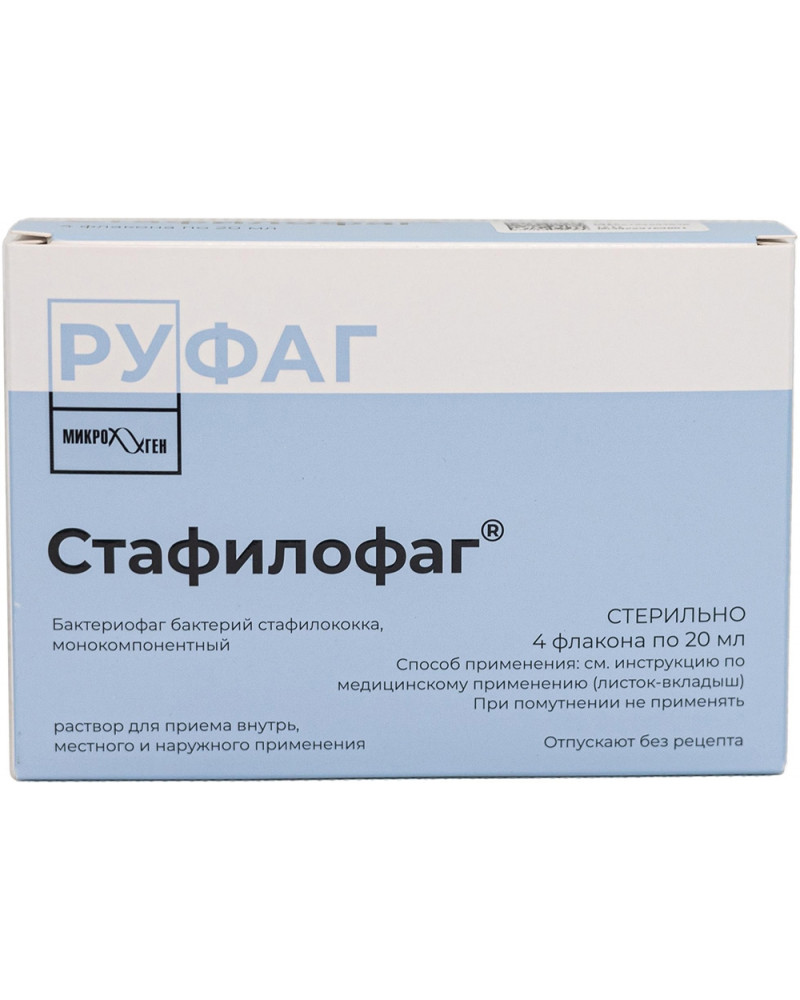


Staphylococcal Bacteriophage (Stafilofag), 20 mL, Pack of 4 Vials
Solution for Oral, Local, and External Use
Composition, Dosage Form, and Packaging
Composition per 1 mL of solution:
Active ingredient: Sterile purified filtrate of bacterial lysates of the genus Staphylococcus (Appelman activity: not less than 10⁻⁵) — up to 1 mL.
Excipient: Preservative — 8-hydroxyquinoline sulfate, 0.0001 g/mL (calculated content); or 8-hydroxyquinoline sulfate monohydrate, equivalent to 8-hydroxyquinoline sulfate, 0.0001 g/mL (calculated content).
Supplied in 20 mL glass vials.
Packaging options:
A. Four 20 mL vials in a cardboard box with instructions for use.
B. Four 20 mL vials in a polymer fixing insert. One fixing insert containing four vials is supplied in a cardboard box with instructions for use.
Description of the Dosage Form
A transparent yellow liquid of varying intensity, which may have a greenish tint.
Pharmacodynamics
The preparation causes specific lysis of bacteria belonging to the genus Staphylococcus.
Indications for Use
Treatment and prevention of purulent-inflammatory and enteric diseases caused by bacteria of the genus Staphylococcus in adults and children.
Ear, nose, throat, respiratory tract, and lung diseases: sinusitis, otitis media, tonsillitis, pharyngitis, laryngitis, tracheitis, bronchitis, pneumonia, and pleurisy.
Surgical infections: infected wounds, burns, abscesses, phlegmon, furuncles, carbuncles, hidradenitis, felons, paraproctitis, mastitis, bursitis, and osteomyelitis.
Urogenital infections: urethritis, cystitis, pyelonephritis, colpitis, endometritis, and salpingo-oophoritis.
Enteric infections: gastroenterocolitis, cholecystitis, and intestinal dysbiosis.
Generalized septic diseases.
Purulent-inflammatory diseases in newborns: omphalitis, pyoderma, conjunctivitis, gastroenterocolitis, sepsis, and other conditions.
Other diseases caused by staphylococci.
In severe cases of staphylococcal infection, the preparation is prescribed as part of combination therapy.
For preventive purposes, the preparation is used to treat postoperative and recently infected wounds and to prevent healthcare-associated infections when epidemiologically indicated.
An important condition for effective phage therapy is prior determination of the pathogen's susceptibility to the bacteriophage and early initiation of treatment.
Contraindications
Individual intolerance or hypersensitivity to any component of the preparation.
Pregnancy, Lactation, Fertility, and Pediatric Use
Use of the preparation may be appropriate for infections caused by phage-susceptible strains of staphylococci, as recommended by a physician.
Adverse Reactions
Allergic reactions may occur.
If you experience any adverse reactions listed in these instructions, if they worsen, or if you notice any other adverse reactions not mentioned here, inform your physician.
Interactions with Other Medicinal Products and Substances
The preparation may be used in combination with other medicinal products, including antibiotics.
Method of Administration and Dosage
The preparation may be administered orally, rectally, and topically. It may also be used for applications, irrigation, and instillation into wound cavities, the vagina, uterus, nose, nasal sinuses, and drained cavities.
Before use, shake the bacteriophage vial and inspect its contents. The solution must be transparent and free of sediment.
Recommended Dosages
| Age | Oral dose per administration | Rectal dose per administration |
|---|---|---|
| 0–6 months | 5 mL | 5–10 mL |
| 6–12 months | 10 mL | 10–20 mL |
| 1–3 years | 15 mL | 20–30 mL |
| 3–8 years | 15–20 mL | 30–40 mL |
| 8 years and older | 20–30 mL | 40–50 mL |
Treatment of purulent-inflammatory diseases with localized lesions should involve both local application and oral administration. The preparation is taken 2–3 times daily on an empty stomach, one hour before meals, starting on the first day of illness. The treatment course lasts 7–20 days, depending on clinical indications.
If chemical antiseptics were used to treat a wound before bacteriophage application, the wound must be thoroughly rinsed with sterile 0.9% sodium chloride solution.
Depending on the location and nature of the infection, the bacteriophage is used as follows:
1. Irrigation, dressings, and tamponade
The preparation may be used for irrigation, compresses, and tamponade in volumes of up to 200 mL, depending on the size of the affected area.
For abscesses, after the purulent contents have been removed by aspiration, the preparation is introduced in a volume smaller than the amount of pus removed.
For osteomyelitis, following appropriate surgical debridement, 10–20 mL of bacteriophage is instilled into the wound.
2. Administration into body cavities
Up to 100 mL may be introduced into the pleural cavity, joint cavities, or other confined cavities. A capillary drain is then left in place to allow further administration of the bacteriophage over several days.
3. Cystitis, pyelonephritis, and urethritis
The preparation is administered orally.
If the bladder or renal pelvis is drained, the bacteriophage may be administered through a cystostomy or nephrostomy tube once or twice daily:
Urinary bladder: 20–50 mL.
Renal pelvis: 5–7 mL.
4. Purulent-inflammatory gynecological diseases
The preparation is introduced into the vaginal or uterine cavity at a dose of 5–10 mL once daily.
For colpitis, 10 mL is used for irrigation or tamponade twice daily. Tampons are left in place for two hours.
5. Purulent-inflammatory diseases of the ear, throat, and nose
The preparation is administered at a dose of 2–10 mL, 1–3 times daily.
It may be used for gargling, rinsing, instillation, or application using moistened turundas (small gauze or cotton pledgets), which are left in place for one hour.
6. Enteric infections and intestinal dysbiosis
The preparation is taken orally three times daily, one hour before meals.
Oral administration twice daily may be combined with one rectal administration of the age-appropriate single dose, given as an enema after bowel evacuation.
Use of Bacteriophage in Infants Under 6 Months
For neonatal sepsis and enterocolitis, including in premature infants, the bacteriophage is administered as high enemas through a gas-relief tube or catheter, 2–3 times daily at a dose of 5–10 mL.
If vomiting and regurgitation are absent, oral administration is also possible. In this case, the preparation is mixed with breast milk.
Rectal administration (as high enemas) may be combined with oral administration.
The treatment course lasts 5–15 days. For recurrent disease, repeated courses may be prescribed.
To prevent sepsis and enterocolitis in newborns in cases of intrauterine infection or a risk of healthcare-associated infection, the bacteriophage is administered as an enema twice daily for 5–7 days.
For the treatment of omphalitis, pyoderma, and infected wounds, the preparation is applied twice daily. A gauze dressing is moistened with the bacteriophage and placed on the umbilical wound or affected area of skin.
If there is no improvement after treatment, symptoms worsen, or new symptoms appear, consult a physician. Use the preparation only for the indications, by the methods of administration, and at the doses specified in these instructions.
Overdose
No cases of overdose have been reported to date.
Precautions and Special Instructions
Shake the vial containing the liquid bacteriophage before use. Do not use the preparation if the solution becomes cloudy.
Because the preparation contains a nutrient medium in which environmental bacteria may grow and cause cloudiness, the following precautions must be observed when opening the vial:
Wash your hands thoroughly.
Disinfect the vial cap with an alcohol-based solution.
Remove the cap without opening the stopper.
Do not place the stopper with its inner surface touching a table or other objects.
Do not leave the vial open.
Store the opened vial only in a refrigerator.
The vial may be opened and the required volume withdrawn using a sterile syringe by piercing the stopper.
Provided that the storage conditions are maintained, the precautions above are followed, and the solution remains clear, the preparation from an opened vial may be used throughout its stated shelf life.